
News & Commentary
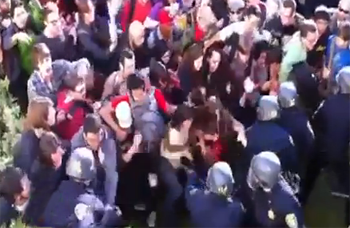
This is What Democracy Looks Like
The ACLU has championed the fundamental rights of unions to organize – the rights of associational freedom and freedom of speech – since its inception more than 90 years ago, beginning with efforts to counter the vehement anti-union crusades of the 1920s.
By ACLU of Northern California

Is Simpler Better for Facebook’s Privacy Policy?
Facebook is working on a “privacy policy written for regular people.” Giving users descriptions that they can actually understand is a great thing, and we’re glad to see Facebook move in that direction. But, as we’ve pointed out with Facebook before, simpler isn’t always better—and some parts of the proposed policy are pretty confusing anyhow. So we’re glad that Facebook plans to make its new privacy policy simpler to read and understand—but we hope it will simply provide better controls and protection too.
Blow to Free Speech: UC Berkeley Chancellor Invited Use of Force Against Student Protesters
Political protest and vigorous debate are vital elements of a healthy democracy and essential attributes of university communities in particular. A university is, after all, a community of ideas, and so universities should be especially welcoming of protest and dissent. For that reason, we found it shocking and disappointing when UC Berkeley responded to peaceful student protesters last fall with baton blows. Even more troubling, the ACLU-NC recently obtained emails in response to a Public Records Act request that show that the police conduct that day was authorized at the very highest levels of the University.
Join Our Letter To Internet Companies
A few weeks ago, we all learned that the Justice Department had obtained an order demanding that Twitter turn over private information about several of its users in connection with the government’s investigation of WikiLeaks.
By ACLU of Northern California
Local Congresswoman Introduces Federal “Do Not Track” Legislation
Today Representative Jackie Speier (D-CA 12th District) introduced the Do Not Track Me Online Act of 2011 (HR 654). This Act would provide much-needed privacy controls for Americans’ online information and create a barrier against unwarranted surveillance.
ACLU Lens: Hearing Next Week in Twitter Wikileaks Case
By Suzanne ItoACLU National Office
By ACLU of Northern California
Court Unseals ACLU and EFF’s Motions on Behalf of Twitter User Birgitta Jonsdottir
By Suzanne ItoACLU National Office
By ACLU of Northern California
Develop for Privacy Challenge: Build Apps to Improve Mobile Privacy
With all their convenience, smartphones can also collect and share vast amounts of data that can paint a detailed picture about someone’s life: your current location, where you have been, who you know, what you search for online, and more. Without strong privacy protections, smartphones and other mobile devices can pose a real threat to your privacy.
Stay Informed
Sign up to be the first to hear about how to take action.
By completing this form, I agree to receive occasional emails per the terms of the ACLU’s privacy statement.
By completing this form, I agree to receive occasional emails per the terms of the ACLU’s privacy statement.