
News & Commentary
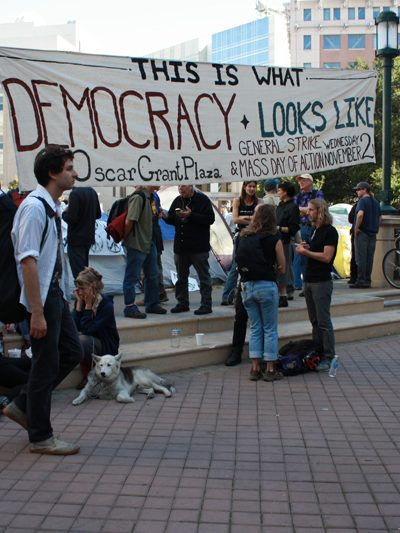
This is What the First Amendment Looks Like
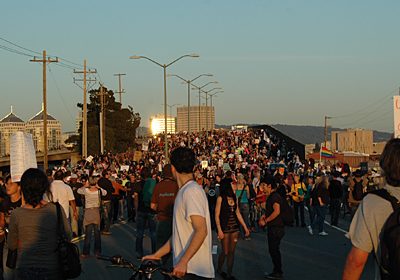
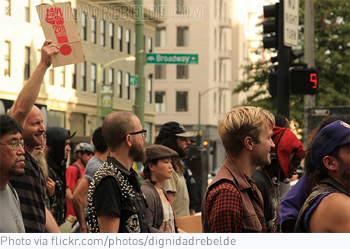
The day after an enormous peaceful demonstration, and the first general strike this country has seen since the 1940s, some of the focus has turned to bonfires and tear gas. But as we continue looking into what happened during late-night clashes between demonstrators and the police, let's not forget the voices of the thousands upon thousands of people who peacefully came together and marched through the streets of Oakland. That's the First Amendment in action.
Oakland Police Internal Investigation Isn't Good Enough
In response to the Oakland Police Department’s (OPD) transformation last week of downtown Oakland into this battle zone-like scene, the ACLU of Northern California and the National Lawyers’ Guild demanded that OPD conduct a full and independent investigation of the recent enforcement actions on Occupy Oakland.
When Will the Oakland Police Learn?
Picture this. In response to a peaceful anti-war protest, the Oakland Police Department uses large wooden bullets, sting ball grenades and shot-filled bean bags, as a result of which at least 58 protesters are injured. That was 2003, and unfortunately sounds eerily similar to reports of OPD's response to an Occupy Oakland demonstration yesterday evening, in which bean bags or other projectiles appear to have been fired directly into crowds and multiple rounds of tear gas were used.

U.S. Continues to Blow Away the Field in Demanding Information from Google
We know that the government takes advantage of outdated privacy law to demand our personal information from online services that collect and hold our data. But what we rarely know is exactly how often this happens: the government isn't required to reveal how many demands for information they make or how many individuals are affected, and companies rarely volunteer this information. One of the very few exceptions is Google, whose Transparency Report shows that the government continues to increase its demands for data about users of online services.

Oakland Police Raid on Occupy Oakland Raises Serious Questions
Today's early morning raid by the Oakland Police Department on Occupy Oakland raises a number of questions.
Online Privacy Law Turns a Quarter of a Century Old Today
Today, the Electronic Communications Privacy Act (ECPA) turns 25 years old. On October 21, 1986, President Ronald Reagan signed ECPA into law. As Wired reported today on the "Aging 'Privacy' Law," ECPA was passed "at a time when e-mail was used mostly by nerdy scientists, when phones without wires hardly worked as you stepped out into the backyard, and when the World Wide Web didn't exist. Four presidencies later, [ECPA] has aged dramatically, providing little protection for citizens from the government's prying eyes — despite the law's language remaining much the same."
Aww, an Anniversary Present for Us, How Nice!
By Christopher CalabreseWashington Legislative Office
By ACLU of Northern California
Want to Read My Email? Not Without a Warrant.
Catherine CrumpACLU National Office
By ACLU of Northern California
Congress Calls Up 1986
This week, our federal online privacy law turns 25. The ACLU is hosting a blog series that will address some of the many reasons why the Electronic Communications Privacy Act of 1986 (ECPA) is in need of an upgrade! Spread the word using #UpdateECPA, and to learn more about your dotRights, visit www.aclu.org/ecpa.
Stay Informed
Sign up to be the first to hear about how to take action.
By completing this form, I agree to receive occasional emails per the terms of the ACLU’s privacy statement.
By completing this form, I agree to receive occasional emails per the terms of the ACLU’s privacy statement.