
SCOTUS Case To Decide Future of TPS for 1.3 Million Immigrants
April 22, 2026 1:00 pm
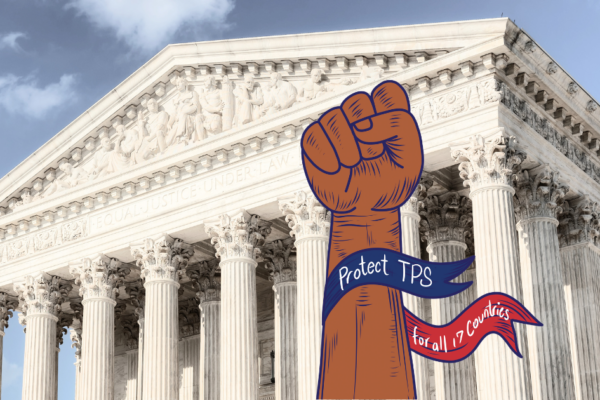
(Washington, D.C.) — On a press call held earlier today, legal experts and affected community members previewed the U.S. Supreme Court oral arguments on April 29th, challenging the Trump administration’s unlawful attempts to terminate Temporary Protected Status (TPS) for Syria and Haiti. The Court will decide whether more than 350,000 Haitian and 6,000 Syrian community members will immediately lose their ability to live and work legally in the United States and potentially be forced to return to unsafe conditions. It could also determine the future of TPS for 1.3 million individuals from all 17 TPS-designated countries, as the administration is asking to make TPS decision-making unreviewable by the court system.
On the call, speakers discussed why the Trump administration’s blanket termination of TPS is unlawful, gave a preview of what to expect during next week’s oral arguments, and underscored that TPS holders are vital members of communities across the country.
Key speaker quotes from the press call are below and a recording is available HERE.
In order of appearance:
José Palma, Coordinator, National TPS Alliance, said “Never let anyone tell you this administration only goes after ‘undocumented’ immigrants. By trying to kill TPS, they are attacking people who are living and working here legally, paying fees and taxes, following all the rules. They are de-documenting people, and it is outrageous. How dare they try to rip more than a million people from their homes, families and jobs, pack them into squalid warehouse prisons, and then dump them in dangerous ‘Do Not Travel’ countries. It's cruel, arbitrary, pointless, needless, and wrong. And shame on the Supreme Court if it blesses this atrocity.”
Viles Dorsainvil, Co-Founder and Executive Director, Haitian Support Center, and a Haitian TPS holder, said “TPS provides dignity, stability, and hope... TPS represents more than protection. It represents the ability of families to stay together. So many folks are experiencing anxiety and fear because if TPS is not extended, they may be separated from their kids... Here in Springfield, Haitians are workers, they are parents, they are leaders. They are part of the fabric of this city. We must continue to value the humanity of those protected under TPS and ensure policies reflect compassion and humanity.”
Sejal Zota, Co-Founder and Legal Director, Just Futures Law, said “Ending TPS is one more chapter in a long history of racially motivated Trump administration attacks on vulnerable people. There is ample record of evidence that anti-black and anti-Haitian animus motivated the administration’s decision to terminate Haiti’s TPS designation. The most damning evidence: President Trump’s own words.”
Adham*, a Syrian TPS holder using a pseudonym, said “There are thousands of Syrians and other TPS holders across this country — doctors, nurses, engineers, teachers, small business owners, parents — who are living with this same weight. People who have spent years becoming part of the fabric of their communities. People whose neighbors, colleagues, and patients would feel their absence immediately and deeply. TPS did not create dependence. It created contributors. And stripping it away would not just uproot individuals — it would leave a hole in communities across America that would take years to fill.”
Ahilan Arulanantham, Professor from Practice and Co-Director, Center for Immigration Law and Policy (CILP), at the UCLA School of Law, said “Congress enacted the TPS statute to create consistency and fairness in the humanitarian protection system. The Trump administration has taken a wrecking ball to the law, demonizing TPS holders and relentlessly attacking TPS itself. The question for the Supreme Court is simple: will it uphold the rule of law, or allow the Trump Administration to destroy it?”
Megan Hauptman, Staff Attorney, U.S. Litigation, International Refugee Assistance Project (IRAP), said “We are in the midst of a sweeping campaign to strip legal status from people who have it and deport them to danger. Ending TPS would be the largest de-documentation effort in U.S. history, but the administration won’t end there if the court gives them the green light to run roughshod over our laws. From TPS holders to resettled refugees, the administration is sending a message that the United States no longer intends to protect people who came here seeking safety, regardless of whether it is lawful or moral.”
Nargis Aslami, Legal Fellow, Muslim Advocates, said “The stakes of this case are high: the Supreme Court’s decision could mean the difference between life and death for nearly 15,000 TPS holders from Syria, South Sudan, Ethiopia, and Somalia. And it could affect whether TPS holders get their day in court—or any justice at all… No matter what happens, we will continue to fight for our clients and push back against this administration’s lawlessness, racism, and xenophobia.”
Emi MacLean, Senior Staff Attorney, ACLU of Northern California, participated in the Q&A and said “The decisions that the Supreme Court makes on both jurisdiction and the merits stand to affect many more people than are directly affected by these two cases,” and added the following prepared comment: “Over a million people rely on TPS because it’s not safe for them to return to their countries because of war or other crises. Former Secretary Noem ignored the law to strip all of these people of their rights. The Supreme Court must reject this brazen lawlessness.”
Additional Information
Related Issues
Related Content
Mullin v. Dahlia Doe
Stay Informed
Sign up to be the first to hear about how to take action.
By completing this form, I agree to receive occasional emails per the terms of the ACLU’s privacy statement.
By completing this form, I agree to receive occasional emails per the terms of the ACLU’s privacy statement.