Haiti & Syria Temporary Protected Status Case at Supreme Court: What You Need To Know

On April 29, the U.S. Supreme Court will hear oral arguments challenging the Trump administration’s attempts to terminate Temporary Protected Status for Syria and Haiti.

Related Content

Court Case
Apr 15, 2026
people at the CA state capitol holding signs that say "keep communities whole" and "keep families together"
  • Immigrants' Rights|
  • +1 Issue

Mullin v. Dahlia Doe

On April 29, 2026, the U.S. Supreme Court heard oral arguments in Mullin v. Dahlia Doe, a case challenging the Trump administration’s attempt to terminate Temporary Protected Status (TPS) for thousands of Syrian immigrants living and working legally in the United States. The case could affect the future of the entire TPS program, which has been a target of the Trump administration and its openly racist mass deportation agenda. TPS is a program established by Congress in 1990 to protect individuals who cannot safely return to their home country due to war, natural disaster, or other emergencies. TPS holders are mothers, fathers, workers, and contributing members of their communities. They rely on this humanitarian protection regime for safety. The Supreme Court’s ruling will impact not only Syrian TPS holders but will also affect whether the Trump administration can move forward with its actions seeking to strip legal status from many others. There are 1.3 million individuals from 17 countries designated for TPS. At the time the Supreme Court will be hearing this case, the Trump administration has terminated TPS for 13 countries—despite ongoing wars and undisputed humanitarian crises. Alongside our co-counsel the International Refugee Assistance Project (IRAP), Muslim Advocates, and Van Der Hout LLP, the ACLU of Northern California represents seven Syrian nationals with TPS or pending applications in Mullin v. Dahlia Doe, a class action lawsuit originally filed in October 2025. Cancelling TPS designation for Syria would subject nearly 6,100 Syrian TPS holders, along with 800 Syrians with pending applications, to immigrant detention and possible deportation to an unsafe country. The plaintiffs argue that the DHS Secretary does not have the legal authority to unilaterally override the TPS statute enacted by Congress, and that it is the role of the judiciary to review the government’s legally dubious actions.
Court Case
Mar 05, 2025
Statue of Liberty
  • Immigrants' Rights

National TPS Alliance v. Noem

On February 19, 2025, the National TPS Alliance and seven Venezuelan TPS holders sued the Department of Homeland Security (DHS) to challenge the vacatur of the previously ordered extension of TPS for Venezuela, and the subsequent termination. On March 20, 2025, the plaintiffs amended the complaint to also challenge the vacatur of the full TPS extension for 500,000 Haitians, with four Haitian TPS holders joining as plaintiffs. The plaintiffs are represented by the National Day Laborer Organizing Network (NDLON), the ACLU Foundations of Northern California and Southern California, the Center for Immigration Law and Policy (CILP) at UCLA School of Law, and the Haitian Bridge Alliance.
Court Case
Jul 09, 2025
Image of TPS advocate by Sam Comen, www.samcomen.com
  • Immigrants' Rights

National TPS Alliance v. Noem (NTPSA II)

National TPS Alliance v. Noem (NTPSA II) is a legal challenge to the Trump administration’s unlawful efforts to dismantle the statutorily mandated Temporary Protected Status (TPS) program for Nepal, Honduras, and Nicaragua, which provides humanitarian protection for people who cannot safely return to their home countries.
Press Release
Apr 22, 2026
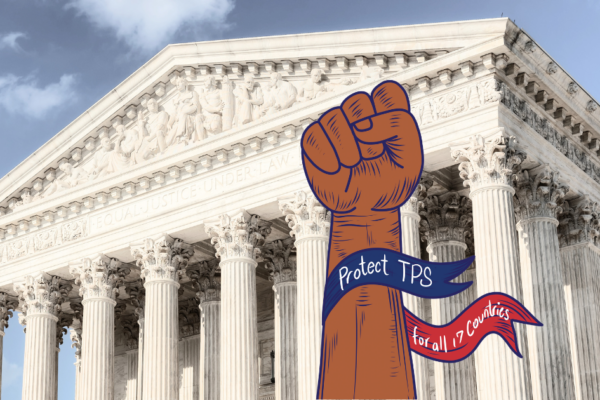
US Supreme Court building with illustration of raised fist bearing a ribbon that says "Protect TPS for all 17 countries"
  • Immigrants' Rights

SCOTUS Case To Decide Future of TPS for 1.3 Million Immigrants

We're challenging the Trump administration's attempt to make virtually all Temporary Protection Status decisions unreviewable by the court system.
Issue Areas: Immigrants' Rights
Court Cases: Mullin v. Dahlia Doe