
When the Government Demands Info About Your Online Accounts
Last updated: September 9, 2026 05:07 pm
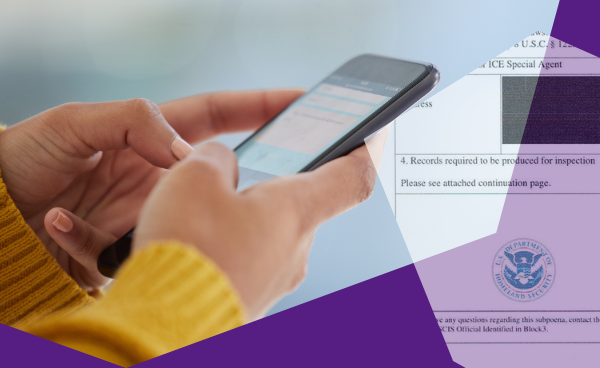
The First Amendment protects the right to document and criticize government actions, including when doing so anonymously online.
But the Department of Homeland Security (DHS) has ramped up efforts to surveil and silence critics using a tool called an “administrative subpoena” or “administrative summons”. When accounts have posted or shared content critical of the administration — particularly of Immigration and Customs Enforcement (ICE) — DHS has issued administrative subpoenas to demand that technology companies hand over information about those accounts. When technology companies get these subpoenas, they often (but not always) provide users with notice. You can see an example of such notice here.
If DHS has issued an administrative subpoena to a technology company to obtain information about you in retaliation for your protected speech you may be able to file a motion to quash the subpoena. If you plan to fight the subpoena, you should immediately let the technology company know and contact the ACLU at https://www.aclu.org/subpoenaintake.
Select a Scenario
What is an administrative subpoena?
A "subpoena" is a form of legal process that demands that the recipient provide certain documents or give testimony that is relevant to an ongoing investigation. In some cases, federal laws let federal agencies — like DHS — issue "administrative subpoenas," but only for specific reasons set out in those laws. Administrative subpoenas are issued directly by agency employees and are not signed by a judge. Sometimes, DHS and other agencies will use administrative subpoenas to try to force technology companies to give up information about users, such as their real names and other identifying information or sensitive information. You can see examples of administrative subpoenas here and here.
It is usually up to individual users to challenge the subpoena in court. If the user does not challenge the subpoena in court, sometimes by a specific deadline, the technology company will often comply with it and provide the government with the requested records.
What is a motion to “quash” a subpoena?
A motion to quash a subpoena is a legal action seeking to have a court declare a subpoena void and unenforceable. There are several reasons a court might quash an administrative subpoena: an administrative subpoena may be improper if it seeks records beyond the scope of what Congress has authorized in the relevant subpoena statute, if it seeks information that is not relevant to a permissible investigation, if it violates the First or Fourth Amendment, or if it violates the Stored Communications Act.
What are my constitutional rights if the government issues an administration subpoena for information about me and my online accounts?
- The First Amendment generally protects the right to criticize the government and to do so anonymously, including by posting online.
- The First Amendment generally protects the right to record law enforcement activity in public and to publish such recordings online.
- The First Amendment generally protects the right to speak and associate online and to curate a feed for followers.
- The Fourth Amendment prohibits unreasonable searches and seizures. In the context of subpoenas, that means a subpoena can only request records that are relevant to a permissible investigation, that are not grossly overbroad or overly burdensome, and that are not issued to harass or for another impermissible purpose.
- The Fourth Amendment generally requires the government to get a warrant from a judge before obtaining the contents of messages and emails.
How do I file a motion to quash an administrative subpoena?
Your attorney should file the motion to quash in the district where compliance with the subpoena is required. For example, if the subpoena directs Meta to produce your identifying information, then you can move to quash it in the Northern District of California, where Meta is located. You can see examples of motions to quash filed by the ACLU and its affiliates here, here, and here.
As soon as you know that you want to try to file a motion to quash, you should notify the technology company that you intend to do so. This should cause the technology company to pause compliance with the subpoena while you go to court. DHS often withdraws its administrative subpoenas after a motion to quash is filed instead of fighting to defend it in court.
If you learn that DHS has issued a subpoena to obtain information about your online account, and you believe the agency did so in retaliation for your speech, please contact the ACLU at https://www.aclu.org/subpoenaintake.
Basis for quashing an administrative subpoena:
- If a subpoena violates the First or Fourth Amendment, that can serve as the basis for a motion to quash. Courts will consider several factors in deciding whether to grant your motion to quash the subpoena. If you are interested in filing a motion to quash this type of subpoena, please contact the ACLU at https://www.aclu.org/subpoenaintake.
- A motion to quash can also be based on DHS’s lack of authority to investigate, the subpoena’s irrelevance to the agency’s investigation, the subpoena’s breadth, the subpoena’s imposition of an undue burden, the subpoena’s failure to provide for a reasonable time to comply, or other grounds.
- DHS’s administrative subpoenas often cite 8 U.S.C. § 1225(d) as their authority. This federal statute authorizes immigration officers to issue subpoenas relating to the people’s right to “enter, reenter, reside in, or pass through the United States” or relating to enforcement of the Immigration and Nationality Act. But such authority does not extend to using subpoenas to unmask someone’s identity for merely posting criticism of ICE or DHS online.
- Another statute that DHS’s administrative subpoenas often cite for their authority is 19 U.S.C. § 1509. This statute authorizes the certain government officials to request records that may be relevant to enforce custom statutes. Thus, if DHS’s subpoena is unrelated to the importation and exportation of goods, it may be outside the scope of DHS’s authority under this statute. A 2017 report by the DHS Inspector General found that the Customs and Border Patrol Office of Professional Responsibility may have exceeded the scope of its authority under 19 U.S.C. § 1509 when it demanded records that would identify an anonymous Twitter user, because those records are not related to importation of merchandise.
- A federal law called the Stored Communications Act permits the government to get certain basic information (your name, address, telephone connection records, length of service, types of service utilized, subscriber number or identity, and means of payment) from communications services with an administrative subpoena. If the government is seeking more, our position is that it should get a court order or a search warrant. Lack of a court order or search warrant could be raised in a motion to quash.
Related Issues
Related Content

John Doe v. Markwayne Mullin

J. Doe v. United States Department of Homeland Security
Stay Informed
Sign up to be the first to hear about how to take action.
By completing this form, I agree to receive occasional emails per the terms of the ACLU’s privacy statement.
By completing this form, I agree to receive occasional emails per the terms of the ACLU’s privacy statement.