
In the wake of the final decisions of this Supreme Court term, and heading into a July 4th weekend that is also the 250th anniversary of the Declaration of Independence, there is a lot to take in and consider about the state of our republic and democracy. In particular, I am struck by several Supreme Court rulings that manifest the persistent and ongoing struggle for our nation to live up to its founding promise in the face of the forces of exclusion.
The founding creed of the United States is contained in the famous opening of the Declaration of Independence. You have heard it at least a thousand times in your life, if not this year alone: “that all men are created equal,” with “unalienable rights” to “life, liberty and the pursuit of happiness,” with governments “deriving their just powers from the consent of the governed.”
Our story as a country is the struggle for the realization of that promise during long periods in which large groups of people were excluded from it: during the genocide and displacement of Indigenous tribes, slavery and the segregation that accompanied and followed it, the limitation of naturalization to “free white persons,” and exclusion from political, economic, and social rights based on sex, among others.
The fight for our nation to live up to its founding promise is a story that has unfolded in every part of the United States and in every generation — right up to this Supreme Court term and consequential cases that the ACLU was deeply involved in:
Safeguarding birthright citizenship (Trump v. Barbara)
No two periods are the same, but attacks on birthright citizenship—the principle that if you are born here, you are a citizen—have always come in times of rising exclusion: against African Americans during slavery, in the era of the Chinese Exclusion Act, and today under President Trump. In the case brought and argued by the ACLU and our co-counsel, a majority of justices declared the president's Executive Order ending birthright citizenship unconstitutional, citing the custom and tradition of birthright citizenship, the text and debates surrounding the ratification of the Fourteenth Amendment, and the precedents that followed.
Indeed, Section I of the Fourteenth Amendment, which states that all persons born in the United States are citizens of the United States and that no person can be denied equal protection of the laws, is the embodiment of our founding creed in the Constitution.
The case of San Francisco-born Wong Kim Ark, decided in 1898, is a key precedent. In United States v. Wong Kim Ark, the Supreme Court upheld the right of citizenship to a child born to Chinese parents—this despite the case occurring in the era of legal racial segregation, marked by the infamous Plessy v. Ferguson decision of 1896 and the passage of the Chinese Exclusion Act in 1882 barring immigration and citizenship to Chinese people.
It is a sign of our exclusionary times that even then the Supreme Court reached its decision by a larger majority than the one reached today.
Protecting immigrants’ rights (Mullin v. Dahlia Doe)
President Washington once wrote that "I had always hoped that this land might become a safe & agreeable Asylum to the virtuous & persecuted part of mankind, to whatever nation they might belong." In contrast, President Trump and his administration have launched a full-scale assault on the rights of immigrants, including undocumented immigrants, asylum seekers, and those with the legal protection known as Temporary Protected Status (TPS) who cannot return to their home countries safely due to war, natural disasters, or other humanitarian crises.
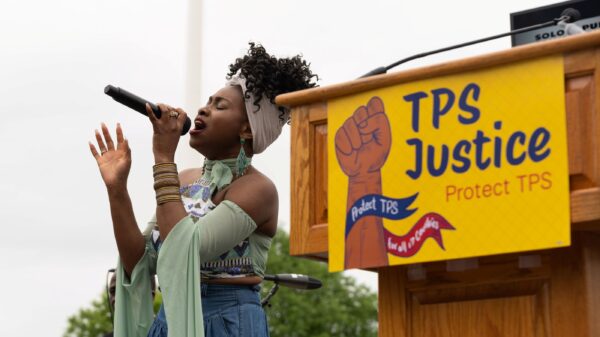
When then-Department of Homeland Secretary Noem issued orders to cancel TPS protection for a range of countries, from Haiti to Venezuela, the ACLU of Northern California and our co-counsel and clients challenged the decision on the basis that it violated the program’s governing statute and that it was based in racial animus. The issue went all the way to the Supreme Court, where we represented Syrian TPS holders in Mullin v. Dahlia Doe. Tragically, the justices’ ruling gave the Trump administration carte blanche to strip TPS holders of their legal status and eliminated most judicial review of TPS decision-making.
We want to be clear on the magnitude of this exclusionary decision: the Trump Administration’s actions to cancel TPS and subject former TPS-holders to deportation represent the largest de-documentation event in United States history. The Supreme Court dealt a devastating blow to the lives and safety of the 1.3 million people living, working, and raising families in the United States with TPS protection, as well as to the law and Constitution. You can read more here.
Even with this major setback, neither our clients, nor the TPS community, nor the ACLU and our partners will stop in our advocacy. We will continue to use available remedies in the courts and in particular we call on Congress to restore and extend legal protections to members of this community and others, like DACA recipients, who are American in every meaningful sense except on paper.
Pursuing equality for transgender women and girls (West Virginia v. B.P.J.)
In West Virginia v. B.P.J., the ACLU challenged a state law categorically banning transgender girls from participating in all school sports, on the basis that the law violated Title IX and the Equal Protection Clause. In a devastating ruling for trans students across the country, the Supreme Court ruled that states can exclude transgender girls from school sports.
Importantly, the court did not grant politicians the broader exclusion we know they wanted from the start: a broad precedent restricting the freedom of all transgender people in our schools, workplaces, and communities. The court also did not require states to exclude transgender athletes, so in many states, including California, trans athletes are allowed to play on girls’ and women’s teams. We will continue to defend trans people's equality and freedom.
Defending the consent of the governed (Watson v. RNC)
The consent on the governed, which the Declaration of Independence names as a prerequisite for a legitimate government, rests on two things: first, our right and ability to vote, and second on ensuring that those votes lead to real representation.
In Watson v. RNC, the Supreme Court did affirm the ability of states to establish rules to receive and count ballots that are cast and mailed on or by election day. This decision affirms a ruling the ACLU of Northern California and our co-counsel secured in a related case in California, Issa v. Weber. These cases threatened the way that 80 percent of Californians and many millions more Americans reliably vote: by mail. With this aspect of the threat averted, ACLU will vigilantly carry out our plans to safeguard the vote from threats or interference in the mid-term elections.
Earlier this year, however, the Supreme Court dealt major blows to representation through its decisions related to redistricting. First, the Supreme Court permitted the partisan redistricting kicked off by President Trump and the state of Texas. That was followed by the decision in Louisiana v. Callais, which dealt a blow to the Voting Rights Act of 1965 and its amendments in 1982. Taken together, the Supreme Court has elevated partisanship as a valid basis for redistricting and then eviscerated the Constitutional protections from racial gerrymandering of the Fifteenth Amendment and those adopted by Congress.
Reflecting on this anniversary in California
The 250th anniversary of the Declaration of Independence is also the 250th anniversary of the Spanish colonists establishing the military outpost known as the Presidio, followed by the founding of the Mission in San Francisco later that year. That confluence is a reminder that the struggle between exclusion and equal protection is a story that precedes our nation’s founding: one carried by tribes of these lands who continue to exist and assert their customs, culture, and sovereignty in the face of genocide, displacement, and forced assimilation.
East and West, North and South, what was here prior to 1776, what happened in 1776, and what would happen after — all of it is the American story. And that story is one of continued struggle.
I look forward to carrying this struggle into the future alongside the members, supporters, allies, and friends of the ACLU.