
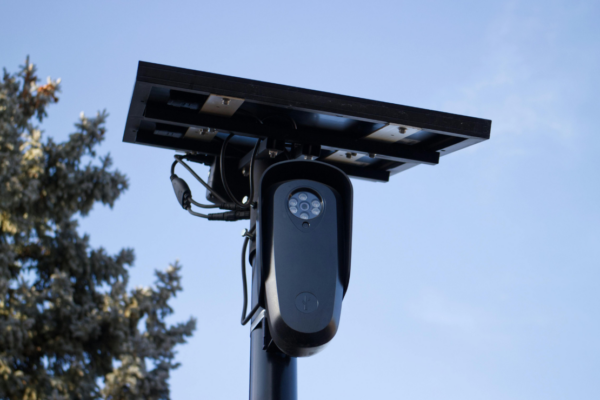
Communities across California are rejecting one of the fastest-growing surveillance networks in the country: automated license plate readers built by Flock Safety and other companies. Over the past year, residents from Santa Cruz to El Cerrito have organized their neighbors, packed city council meetings, and demanded answers—and one by one, cities are canceling their Flock contracts and taking the cameras down.
Flock’s automated license plate readers (ALPRs) aren’t like normal traffic cameras. They record every car that comes into view, and an AI algorithm catalogs the make, model, color, and license plate number, along with the location, date, and time. That information is uploaded to massive databases that can be shared with any law enforcement agency with a Flock contract—with little regulation or oversight on how the data is used. With a few clicks, local, state, and federal agencies, including ICE, can access a trove of data revealing millions of drivers’ daily movements as they travel to and from home, work, school, doctors’ offices, and places of worship.
The dangers are not theoretical. Last year, a Texas sheriff’s deputy searched more than 83,000 far-flung ALPR cameras across the nation to find a woman who had sought reproductive health care. And from August 2024 through February 2025, the San Francisco Police Department reportedly let out-of-state agencies run more than 1.6 million searches of the city’s license plate reader database —in violation of state law—including at least 19 searches marked as related to U.S. Immigratino and Customs Enforcement (ICE).
As use of these cameras has spread, so has public understanding of what they can do. “People now understand how surveillance data is part of the ICE deportation machine,” said Tammy Kreznar, senior organizer at the ACLU of Northern California, who has supported communities organizing against Flock across the region. For many people, mass tracking is simply incompatible with a free society.
“Authoritarian governments are the places that have cameras everywhere, where you can’t go anywhere without being tracked,” added Kreznar. “That’s not what we want in our country.”
Communities are fighting back—and winning. In January, Santa Cruz became the first city in California to cancel a Flock contract, and took the cameras down in March. Mountain View and Santa Clara County have since ended their contracts. In May, after residents turned out at council meetings and an audit revealed that federal agencies had accessed data from El Cerrito’s 40 cameras, the City Council voted against renewing the city’s contract. The cameras went dark in June and are now being removed. At current count, more than a dozen California cities have terminated their contracts with Flock.
These victories are community driven. In city after city, neighbors are educating each other, sharing what they learn, and showing up to city council meetings—again and again—until their elected officials act. ACLU NorCal is proud to support and amplify this grassroots movement, and Kreznar’s first piece of advice to residents who want to join it is to find each other. “Figure out if there’s already a DeFlock group in your city,” she said. “If there isn’t one, ask yourself: What is the existing activist base in your community—people working on immigrant rights, doing rapid response? Those are already built-in networks you can plug into.”
Education is at the heart of these campaigns. Some local officials are unaware of how these systems work and of the dangers they pose. Residents who learn the facts can share them, giving their council members the understanding and the community backing they need to act. To make that easier, we have developed an advocacy toolkit, www.aclunc.org/get-the-flock-out, with guidance for finding out whether ALPR cameras are operating in your city, talking points for council meetings, and other resources to help you organize.
We are also fighting Flock surveillance systems in court. In November, the ACLU of Northern California and the Electronic Frontier Foundation sued the city of San Jose on behalf of local civil rights groups to challenge San Jose police officers’ practice of searching location information collected by Flock cameras without a warrant. The San Jose Police Department has blanketed the city with nearly 500 cameras, uses that network to collect millions of records a month about people’s movements, and, at the time our lawsuit was filed, stored the data for a year. It allows its own officers—and other law enforcement officials from across the state—to search that database at will and without a warrant.
The pressure is working. After we filed the lawsuit, the San Jose City Council cut its data retention period from a full year to 30 days and moved to end data sharing with federal agencies. But the core constitutional violation continues, and so does our case.
Mass surveillance is not inevitable. When residents organize and demand accountability, contracts get canceled and cameras come down.
Find out whether Flock cameras are operating in your community and get the tools to act at www.aclunc.org/get-the-flock-out.