
News & Commentary
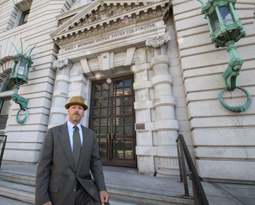
California Appeals Court Says Lethal Injection Rules Are Illegal
Yesterday afternoon the California Court of Appeal held that our prison system has, once again, completely failed to comply with state law when it adopted a problematic procedure for carrying out lethal injection executions.

Are Online Phone Records Vulnerable Too?
In light of recent revelations that the Department of Justice secretly requested the telephone records of Associated Press (AP) journalists, we started thinking about newer calling services, like Google Voice. We know that some journalists also use these services. Are these records vulnerable too?
Court Ruling Gives FBI Too Much Leeway on Surveillance Technology
Today, a federal district judge in Arizona issued a very disappointing decision concerning the government's obligations to be candid with courts about new technologies they are seeking a warrant to use. The ACLU and the Electronic Frontier Foundation filed an amicus brief arguing that when the government wants to use invasive surveillance technology, it has an obligation to explain to the court basic information about the technology, such as its impact on innocent third parties. This is necessary to ensure that courts can perform their constitutional function of ensuring that the search does not violate the Fourth Amendment. Unfortunately, today's decision trivializes the intrusive nature of electronic searches and potentially opens the door to troubling government misuse of new technology.
The Fight for the Right to Know Goes On
Assemblymember Bonnie Lowenthal (D-Long Beach) announced this morning that the California Right to Know Act (AB 1291) will not be voted on this year but she will keep working to pass it next year.
Advocating for LGBTQ Youth
Over the years, the north steps of the State Capitol have seen some fierce advocacy by queer youth from across the state of California. The ACLU of California is keeping that legacy alive in the 2013 legislative cycle. The GSA Advocacy & Youth Leadership Academy (GAYLA) is a three-day intensive training in the legislative process and advocacy that brings the voices of lesbian, gay, bisexual, transgender, and queer or questioning (LGBTQ) students to the forefront of the discussion. Today, it culminates with Queer Youth Advocacy Day, a day where youth speak their minds and voice their concerns directly to their representatives.
By ACLU of Northern California
Don't Rush Into Mass Surveillance in San Francisco
I grew up outside Boston and used to watch the Marathon as it ran by, near where we lived. My heart goes out to the City of Boston and everyone impacted by recent events.

ACLU of California Responds to Gang of 8 Immigration Plan
The ACLU of California welcomes the federal comprehensive immigration reform bill announced late Tuesday night by the Senate Gang of 8. This historic bill has the potential to advance the civil rights and liberties of all Californians and to set the stage for a roadmap to citizenship for the nearly 2.6 million undocumented immigrants who currently live in our state.
ACLU-NC Urges Redding City Council Not To Write A Blank Check For Drone Testing
Tonight, the Redding City Council will consider whether to put the City on the path toward becoming a drone testing site. The ACLU of Northern California has urged the City Council not to approval the proposal at this juncture. (You can read our letter to the City Council here.) The proposal currently before the City Council is nothing more than a blank check. It offers the community no assurances whatsoever that their privacy will not be invaded, and it provides the City Council with no role in overseeing the process of transforming Redding into a drone test site. Drone proponents have emphasized that the integration of drones into domestic airspace is inevitable. While that may be the case, it is therefore all the more essential that Redding, under the leadership of its City Council, take this opportunity to advance not only technology, but also civil rights, privacy, and core values of our constitution. Drones pose significant threats to privacy because they can easily be used for warrantless mass surveillance. Before any community makes the important decision whether to unleash drones into the skies, it should undertake a participatory and informed debate, and it should ensure that meaningful privacy safeguards are in place. At this juncture, essential information about the drone proposal are lacking.
Stay Informed
Sign up to be the first to hear about how to take action.
By completing this form, I agree to receive occasional emails per the terms of the ACLU’s privacy statement.
By completing this form, I agree to receive occasional emails per the terms of the ACLU’s privacy statement.