
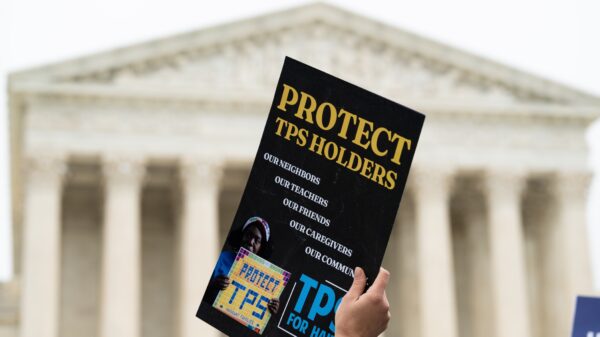
(LOS ANGELES) – The Trump administration’s initial push to end Temporary Protected Status (TPS) for Haitians relied on false statements and a failure to comply with federal law to justify ending the program for more than 350,000 immigrants living legally in the United States, according to newly released documents.
This new information comes as the U.S. Supreme Court is poised to determine the fate of the TPS program in the case Miot v. Noem. A decision is expected before the end of June. Today, the plaintiffs in Miot filed a motion to dismiss the petition at the Supreme Court, relying in part on new documents. The documents, released as part of a parallel lawsuit known as NTPSA v. Noem, show the Department of Homeland Security (DHS) lied when it posted in a press release and the Federal Register that it had engaged in the required consultation on country conditions, including with the U.S. State Department.
In fact, no such consultation occurred. Instead, in an unprecedented move, DHS rushed to terminate Haiti’s TPS—regardless of the country conditions and based on the U.S. “national interest” alone.
“It should matter that former DHS Secretary Noem lied,” Emi MacLean, attorney with the ACLU of Northern California, representing the plaintiffs in NTPSA v. Noem. “The Trump administration violated the law, and then asked the Supreme Court to endorse their illegal actions. The Supreme Court should not be complicit. Checks and balances exist for a reason, and the government’s actions here demonstrate exactly why the government must not be granted unfettered discretion.”
Until now, very little was known about how the decision was made to end Haiti’s TPS because the Supreme Court agreed to hear the Miot case before any final decision by the lower courts, and setting an accelerated schedule.
“It makes me sad that the U.S. government is misrepresenting the truth about conditions in Haiti to be able to deport people like me,” said A.A., a Haitian TPS holder and plaintiff in NTPSA v. Noem. “I have been here since I was a kid, and there is no safety or future for me in Haiti right now. My country is in a deeper crisis than ever.”
Currently at issue before the Supreme Court is how then-DHS Secretary Kristi Noem sought to terminate Haiti’s TPS shortly after taking office. In February 2025, she shortened the TPS protections and then moved to end TPS in July. When that was blocked by litigation, Noem sought to end it again in November. Multiple lawsuits ensued, and those legal challenges have thus far blocked that termination from taking place.
The new documents shed light on the irregularities in the termination—and the government’s misrepresentation of a central fact.
The law and settled practice are that the agency must make TPS decisions based on an analysis of country conditions by the Departments of State and Homeland Security. The TPS statute also requires that DHS consult with the State Department prior to making a TPS decision. Noem, however, did neither of those for the July termination —yet claimed she did—when making the formal announcement of the decision online and in the Federal Register.
After career experts recommended an automatic-extension of TPS for Haiti, at the 11th hour, a political appointee reversed course and forced a termination regardless of country conditions. Noem then did so, even knowing that the State Department did not provide the legally-required consultation.
"It would be obviously unconscionable to strip 350,000 Haitian migrants of their lawful immigration status based on a lie,” said Jessica Bansal, attorney with the National Day Laborer Organizing Network, representing the plaintiffs in NTPSA v. Noem. “What remains to be seen is, who will prevent it. The government says courts have no authority to stop even an illegal TPS termination. If the Supreme Court were to accept that radical position, it will be up to Congress, and the people, to prevent this tragedy."
Congress created TPS as part of the Immigration Act of 1990. It provides a work permit and protection against deportation for individuals from countries facing environmental disasters, armed conflicts, or other crises. The TPS statute has clear requirements, including that the Secretary of Homeland Security evaluates the conditions in a country to determine whether it is safe to return, and to consult with the Department of State and other agencies when determining whether to extend such protection. This program protects over one million people whose countries are unsafe due to war, natural disaster, or other crises.
This isn’t the first time the Trump administration has publicly made misleading or false statements about TPS.
During the first administration, courts found irregularities during the TPS decision-making process that were deemed illegal. A PBS story reported that Trump “appointees rewrote or edited those State Department findings to suit their purposes.”
“Haitian TPS holders followed all the rules. Like all TPS holders, they are mothers and fathers, friends and neighbors. Many have lived here lawfully for more than 15 years,” said Jose Palma, Coordinator of the National TPS Alliance, the lead plaintiff in the NTPSA v. Noem litigation. “Their contributions to our economy and culture enrich us all. They deserve better than this."
The plaintiffs in NTPSA v. Noem are represented by the National Day Laborer Organizing Network (NDLON), the ACLU Foundations of Northern California and Southern California, Haitian Bridge Alliance (HBA), and the Miñana Family Center for Immigration Law and Policy at the UCLA School of Law. Ahilan Arulanantham, Faculty Co-Director at the Miñana Center, argued before the Supreme Court in Mullin v. Doe, which was consolidated with Miot v. Noem, and is co-counsel in NTPSA v. Noem.
See below for relevant documents:
Miot v. Noem Motion to Dismiss as Improvidently Granted: Case Filing
Miot v. Noem Exhibits (from NTPSA disclosures): Case Appendix
Related Issues
Related Content
Mullin v. Dahlia Doe
Stay Informed
Sign up to be the first to hear about how to take action.
By completing this form, I agree to receive occasional emails per the terms of the ACLU’s privacy statement.
By completing this form, I agree to receive occasional emails per the terms of the ACLU’s privacy statement.