
2024 Annual Report
This report includes highlights of our work in 2024, while looking head at the urgent battles under the second Trump administration.

All Publications
Apr 13, 2023
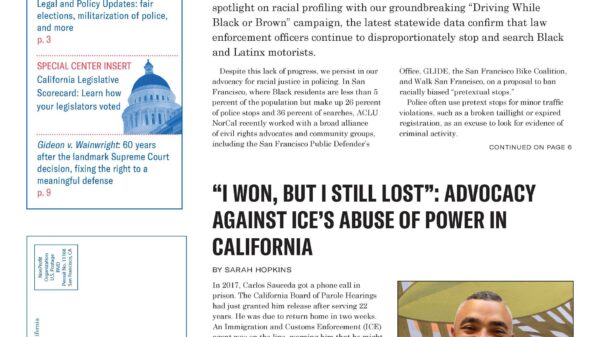
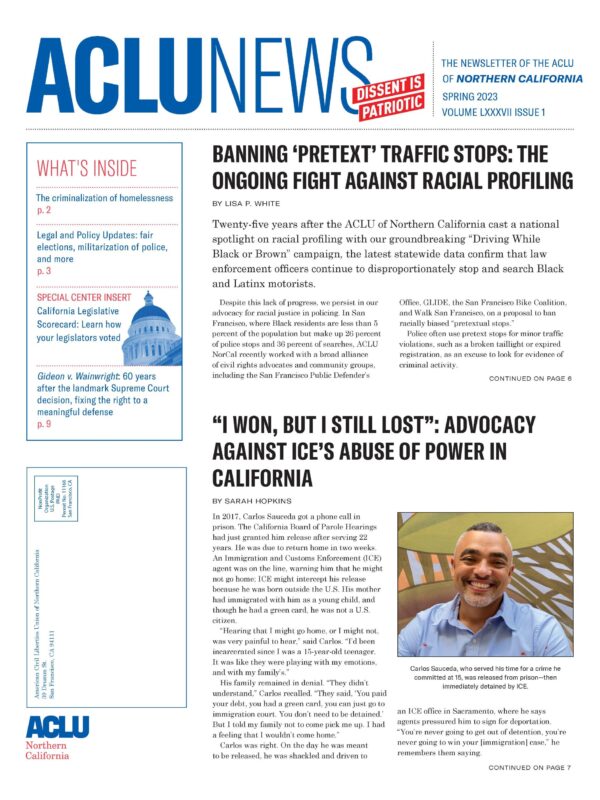
ACLU News: Spring 2023
In this issue: banning 'pretext' traffic stops, resisting California's criminalization of homelessness, and 2022 State Senate legislative scorecard.
Oct 13, 2022

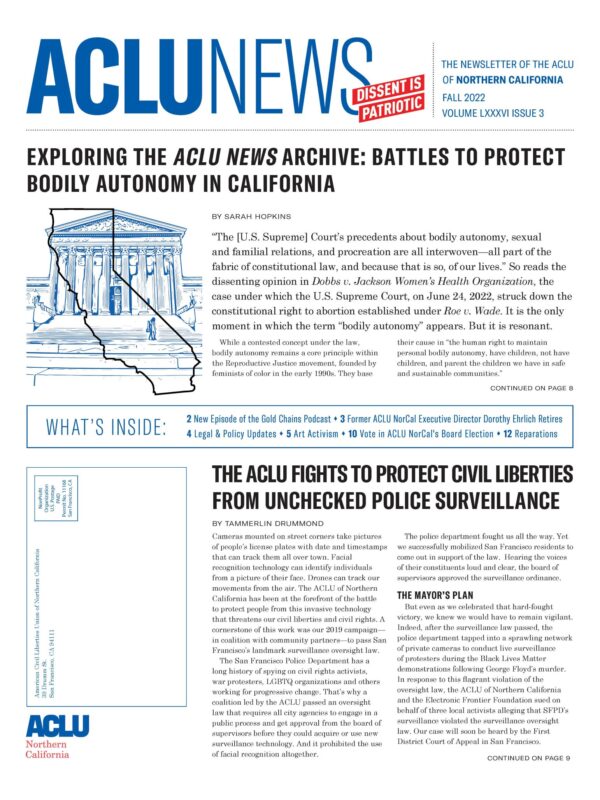
ACLU News: Fall 2022
In this issue: ACLU fights to protect civil liberties from unchecked police surveillance, new Gold Chains podcast episode spotlights enslavement of Native children, Marin sheriff stops sharing drivers' locations with ICE and CBP, and more.
Jul 13, 2022

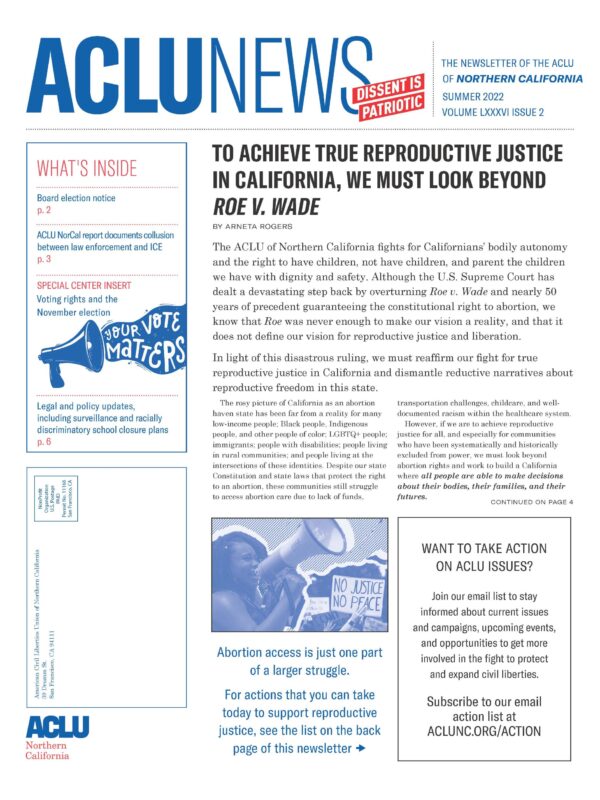
ACLU News: Summer 2022
In this issue: Reproductive justice in California, report reveals long-suspected collusion between Central Valley law enforcement and ICE, 2022 voter guide, and more.

Jul 6, 2022

Black Bill of Rights: a Community Toolkit
In 2021, we partnered with the Black Bill of Rights to develop a community toolkit for people seeking to address systemic oppression and anti-Black racism. The Black Bill of Rights is a resource hub that provides education, templates, and data for communities to take action and develop policies and practices that restore freedom and opportunity for Black people in the United States. It is an ever-evolving online place for Black leaders to share, learn from one another, and grow together.
Mar 2, 2022
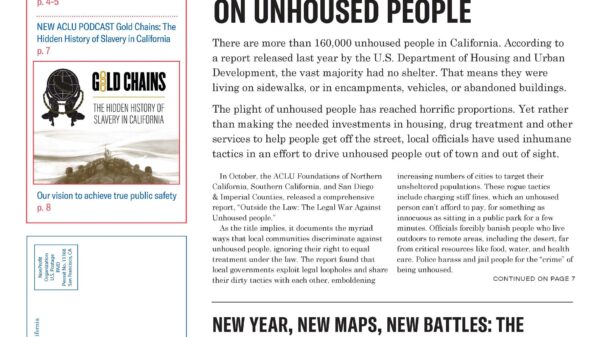
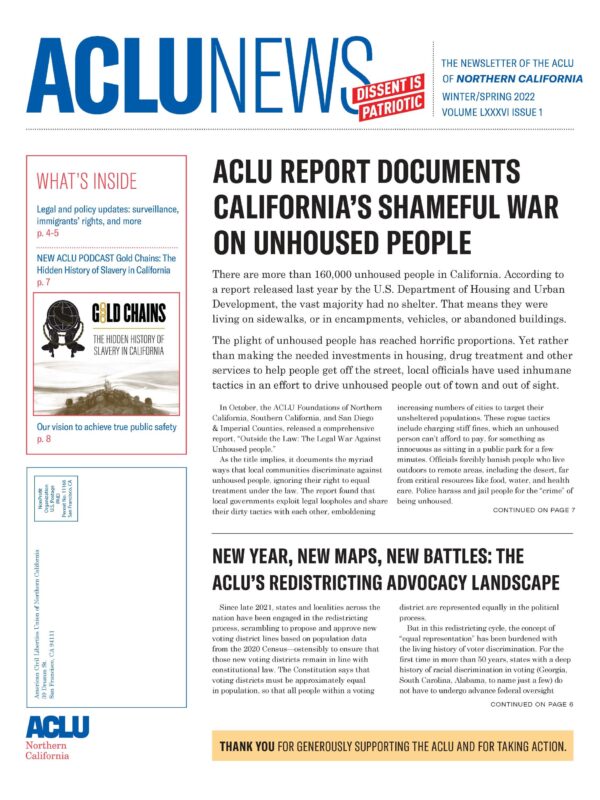
ACLU News: Winter-Spring 2022
In this issue: ACLU report documents California's shameful war on unhoused people, the ACLU's redistricting advocacy landscape, groundbreaking settlement yields protections for immigrants detained by ICE, and more.
Feb 9, 2022
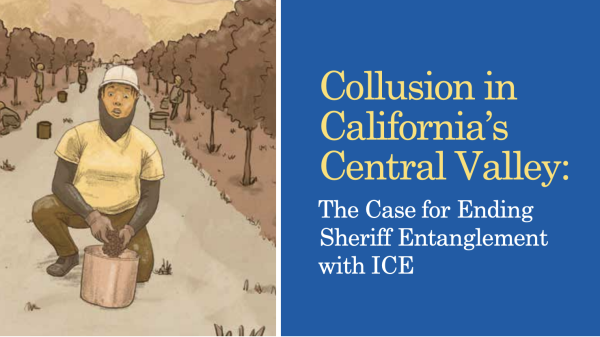
Collusion in California's Central Valley: The Case for Ending Sheriff Entanglement with ICE
Over the past decade, the California Legislature enacted a trio of critical laws intended to protect people from collusion between state and local law enforcement agencies and agencies engaged in immigration enforcement. Certain sheriffs and local law enforcement agencies, however, have circumvented these laws and undermined the protections envisioned for California immigrants — at times in consultation with U.S. Immigration and Customs Enforcement (ICE).
Jan 25, 2022

In(Justice) in Sacramento: A Case for Change and Accountability
Sacramento County is an important jurisdiction for reform of the laws and policies that produce mass incarceration. The county incarcerates roughly 10,000 people between county jails and state prisons. The DA, Sheriff’s Department, Probation Department, and courts consume 64 percent of the County General Fund, yet the county’s crime rate — though slightly higher than the state and federal average — has declined steadily since 2006. People of color are incarcerated at disproportionately high rates in Sacramento and feel the collateral effects of the carceral system most acutely. This report outlines the practices and policies of Sacramento DA Anne Marie Schubert’s office through an analysis of prosecution data and qualitative research methods. Findings show ample opportunities for reform, many of which are within the DA’s purview and can be modeled after policies in other jurisdictions.
Jan 19, 2022
In(Justice) in Merced County: A Case for Change and Accountability
California and the United States as a whole incarcerate more people than anywhere else in the world, in both absolute and per capita terms1 District attorneys (DAs) in California can have a powerful role in curbing mass incarceration and hold tremendous discretion within the criminal legal system, but they have historically been subject to limited accountability. This report outlines the practices and policies
of Merced County District Attorney Kimberly
Helm Lewis’s office by presenting quantitative and qualitative findings


Stay Informed
Sign up to be the first to hear about how to take action.
By completing this form, I agree to receive occasional emails per the terms of the ACLU’s privacy statement.
By completing this form, I agree to receive occasional emails per the terms of the ACLU’s privacy statement.