Legal Teams React to SCOTUS Arguments on Cases Challenging Termination of TPS for Haiti and Syria
April 29, 2026 4:00 pm
(Washington, D.C.) — Today, the Supreme Court heard oral arguments in Mullin v. Dahlia Doe and Trump v. Miot, two class action lawsuits challenging the Trump administration’s attempts to terminate Temporary Protected Status (TPS) for hundreds of thousands of people from Syria and Haiti, respectively. The decision could also impact more than 1.3 million TPS holders from all 17 TPS-designated countries, as the administration is asking to make TPS decision-making unreviewable by the court system. The Trump administration has attempted to terminate all 13 TPS designations that have come up for review, and this is the first time the Supreme Court will substantively address the government’s claim that there should be no judicial oversight over whether the terminations comply with the TPS statute.
Syrian plaintiffs are represented by the International Refugee Assistance Project (IRAP), Muslim Advocates, and Van Der Hout LLP, alongside the ACLU of Northern California, ACLU National, the Center for Immigration Law and Policy (CILP) at the UCLA School of Law, and the National Day Laborer Organizing Network (NDLON). Haitian plaintiffs are represented by Just Futures Law, Bryan Cave Leighton Paisner (BCLP), Kurzban, Kurzban, Tetzeli & Pratt, and Giskan, Solataroff & Anderson.
The following are reactions from the attorneys who argued today’s cases:
Ahilan Arulanantham, Professor from Practice and Co-Director, Center for Immigration Law and Policy (CILP), at the UCLA School of Law, said: “This case presents a simple question: can our government ignore the law when it tries to take away someone’s immigration status? Here the government seeks to de-document 1.3 million people from 16 countries which remain in crisis, without any opportunity for judicial review. Many of the people affected have spent years in this country building lives, paying taxes, and contributing to their communities. In response, we have asked the United States Supreme Court to send a message both to this administration and those of the future: the laws Congress passes govern every administration, regardless of party. It should order the Trump Administration to follow the rules, rather than giving it a blank check for mass deportation."
Geoffrey Pipoly, Partner, Bryan Cave Leighton Paisner (BCLP), said: “To the entire TPS community: we hope we’ve vindicated you today. It remains to be seen, but win or lose, this is what leaving it all on the floor looks like.”
Co-counsel organizations and plaintiffs in legal challenges to the terminations of TPS for Syria and Haiti also responded to the proceedings:
Sharif Aly, President, International Refugee Assistance Project (IRAP), said: “While we don't know what the Supreme Court will ultimately decide, we know the stakes couldn’t be higher. The Court’s decision will determine the futures of not just hundreds of thousands of Haitian and Syrian TPS holders, but potentially 1.3 million people from all TPS-designated countries. The Court now faces a choice about whether it will uphold the checks and balances at the heart of the Constitution or whether the President can run roughshod over the laws created by Congress. Just as importantly, it faces the moral question of whether our country will destabilize countless families, communities, and the economy by stripping legal status from people who have it and sending them back to danger in Haiti, Syria, and beyond.”
Jessica Bansal, TPS Counsel, National Day Laborer Organizing Network (NDLON), said: “Today, the government told the Supreme Court that DHS can strip humanitarian protections from 1.3 million lawfully present immigrants, in violation of laws enacted by Congress, and courts are powerless to do anything. TPS holders, both in and out of the courtroom, powerfully disagreed. Their strength and courage is an inspiration, and the law is on their side.”
Dahlia Doe, a Syrian TPS holder and lead plaintiff in Mullin v. Dahlia Doe, said: “When leaders use language that paints immigrants as a problem, it makes people like me feel like our lives and contributions do not matter. But we are not a threat. We are part of this country. I am the only one in my family on TPS. Losing it would mean being separated from the people I love and the responsibility I carry for them every day. This case is not just about Syrians. It is about thousands of people across different communities who built their lives here in good faith and are now at risk of losing everything. We are not asking for anything extraordinary. We are asking for the chance to live with stability, to stay with our families, and to be treated with basic dignity.”
Viles Dorsainvil, a Haitian TPS holder, plaintiff in a legal challenge to the termination of TPS for Haiti, and Co-Founder and Executive Director, Haitian Support Center, said: “We are here because we know what is at stake. We know what it is like to struggle to know what will happen tomorrow. The question before the court is not only a legal one, but a moral one. We urge a decision that reflects our values. I will continue to stand and advocate for a permanent and dignified solution for all those who call this country home.”
Omar Farah, Executive Director, Muslim Advocates, said: “The administration's attack on Temporary Protected Status is cruel and bigoted. It is also dangerous. The futures of over one million people are in the balance as the Supreme Court decides whether to uphold the administration’s effort to arbitrarily strip legal status from immigrants of color, or whether it will act as a check against presidential overreach. The correct legal and moral choice is to preserve TPS—a humanitarian program Congress embedded in our immigration policies to protect those who cannot safely return to their home countries. Whatever the outcome, we are honored to join TPS holders, who are our family-members, neighbors, and colleagues, in demanding their right to continue building lives of dignity, promise, and safety.”
Emi MacLean, Senior Staff Attorney, ACLU of Northern California, said: “This administration, by its own admission, wants to end the TPS program entirely. But they cannot defy the law just because they don’t like it. The Trump administration has created a farce of a process to justify stripping humanitarian protections from over a million people. The Court should recognize the plain illegality of the government’s actions, which have devastating effects.”
Sejal Zota, Co-Founder and Legal Director, Just Futures Law, said: “Our side presented very forceful arguments to the Court as to why the law is clearly on our side. But equally as important to this litigation, is the organizing and advocacy by TPS holders. I hope this court does the just and moral thing but either way, we vow to keep fighting and doing all we can to prepare TPS communities for what’s to come.”
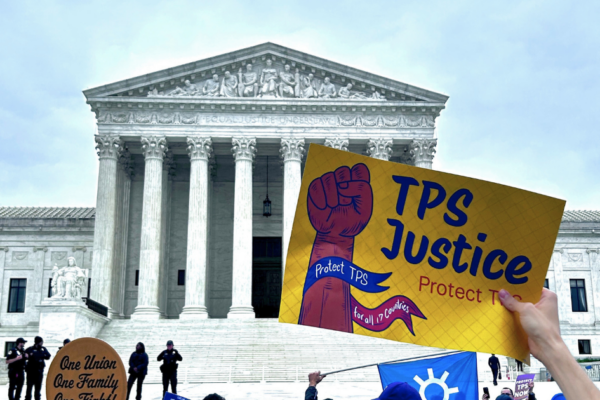
During oral arguments, TPS holders and their supporters rallied outside the Supreme Court. Learn more about the event and speakers here.
Additional Information
Related Issues
Related Content
Mullin v. Dahlia Doe
Stay Informed
Sign up to be the first to hear about how to take action.
By completing this form, I agree to receive occasional emails per the terms of the ACLU’s privacy statement.
By completing this form, I agree to receive occasional emails per the terms of the ACLU’s privacy statement.