Voter ID is voter suppression
Californians face a decision that could shape the state’s elections for decades to come. After numerous failed attempts to push a bill through the legislature, in March Republican Assemblymember Carl DeMaio of San Diego and his allies submitted signatures to place a voter ID initiative on the November ballot. Defeating this ballot measure is the ACLU of Northern California’s top election priority.
If passed, Californians voting by mail would have to write the last four digits of a government-issued ID on the outside of their mail ballot envelope, raising privacy concerns and the risk of identity theft. A mistake, such as a transposed or illegible digit, could result in a rejected ballot.
Voting by mail is incredibly popular — more than 80% of Californians who voted in the 2024 presidential election returned a mail ballot — so this initiative could have a profound impact on our elections. People voting in person would be required to show a driver’s license or other government-issued ID.
The ballot initiative also directs state and county elections officials to verify citizenship through government databases riddled with errors that could wrongly flag naturalized citizens and other eligible voters for removal from the voter roll. The state estimates that the initiative could cost California and local governments tens of millions of dollars to implement, plus millions more annually to satisfy the new requirements.
The entire electoral process in California is secure. The state already requires ID, such as a Social Security number or driver’s license, to register to vote. Officials confirm voters’ identity and eligibility when they register. Poll workers check people in by name and address. And county registrar offices verify the signature on every mail ballot.
For years, conservative activists have promoted false allegations of widespread voter impersonation and noncitizen voting to pass restrictive voter ID laws in 36 states. Multiple nonpartisan studies have thoroughly debunked these claims, including a Brookings Institution analysis of the Heritage Foundation’s election database that found just 77 documented accounts of noncitizen voting out of billions of ballots cast over a 20-year period.
Voter ID requirements are a form of voter suppression designed to disenfranchise people of color, seniors, low-income voters, college students, and voters with disabilities, all of whom are less likely to have valid ID.
People without a current ID, including those who have legally changed their names or who move frequently, also may face challenges if they are required to present ID at the polls.
“This harmful initiative would create additional obstacles for voters at a time when we should be encouraging more people to participate in the democratic process,” said Angélica Salceda, director of ACLU NorCal’s Democracy, Speech, and Technology project. “ACLU NorCal has partnered with a broad coalition of voting and civil rights organizations to defeat this measure, and we call on Californians to reject this cynical ploy to deprive citizens of their fundamental right to vote.”
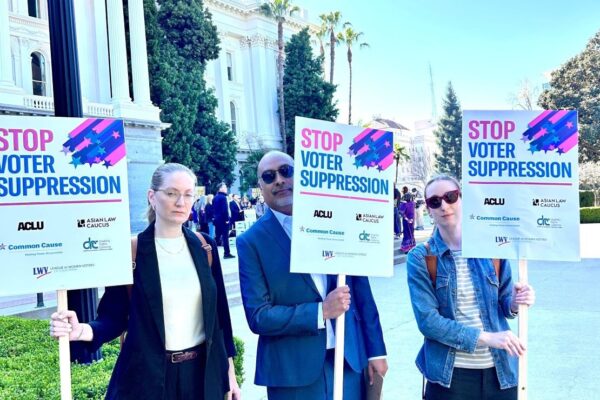
The ACLU of Northern California spearheaded the launch of the opposition campaign and donated $250,000 to fight the ballot measure. When DeMaio’s group submitted the petition signatures during press events at the state capitol and four county election offices across the state, representatives from the ACLU, the League of Women Voters of California, and Common Cause showed up to deliver a simple message: This measure is about voter suppression, not election security. Coalition spokespeople were quoted by more than two dozen media outlets, including the Los Angeles Times and the Sacramento Bee.
Public campaign financing is good for democracy
We have endorsed the California Fair Elections Act of 2026 which would allow the use of public funds in state and local campaigns in California. Currently, only charter cities can establish public financing systems. This ballot measure addresses a long-term concern, heightened in the aftermath of the U.S. Supreme Court’s Citizens United decision, about the role of money in politics.
Public campaign financing programs expand the pool of people who can run for office, reduce the undue influence of wealthy donors and special interests in campaigns and public policy, and give residents at all income levels a greater voice in the political process.
Safeguarding elections
We are also working on additional issues that could affect the election. In partnership with voting rights advocates and ACLU affiliates across the country, the national ACLU is leading a multistate challenge to the administration’s attempt to seize sensitive voter data, including dates of birth and partial Social Security numbers. Earlier this year, a district court dismissed the Department of Justice’s lawsuit against California, but the government filed an appeal. Thus far, DOJ has sued 30 states. But this brazen federal overreach isn’t the only litigation that could upend the midterms.
In March, the U.S. Supreme Court heard oral arguments in a case challenging a Mississippi statute allowing mail ballots postmarked by Election Day to be counted if they arrive up to five days after the election. The conservative justices appeared to agree with the plaintiffs’ argument that the statute violates federal election law. The court’s decision will have some bearing on San Diego Republican Rep. Darrell Issa’s lawsuit seeking to stop California from counting ballots that arrive after Election Day. Although the case has been temporarily paused pending the Supreme Court’s decision, if Issa’s challenge ultimately succeeds, hundreds of thousands of California voters whose ballots arrive after Election Day could be disenfranchised in November. We will continue to fight in court for every ballot to be counted.
At this point in the midterm election season, much remains in flux. But no matter what happens, the ACLU will fiercely protect your right to vote and work diligently to get out the vote.
Paid for by ACLU of Northern California Issues Committee. Ad Committee’s Top Funder: ACLU Foundation of Northern California.